


What changes at 65
Turning 65 is a meaningful milestone for health coverage. For most Americans, it marks the start of eligibility for Medicare, the federal program that becomes the foundation of health insurance in later life. The choices you make at this point can affect your costs and access to care for years ahead, so taking time to understand your options matters.
Before 65, most working-age adults rely on employer coverage or plans purchased through the Health Insurance Marketplace. After 65, Medicare becomes available regardless of employment status. Some people continue employer coverage alongside Medicare for a time, while others transition fully. The right path depends on personal health needs, budget, and whether you or a spouse still has qualifying workplace insurance.
This article is general information, not advice
The information here is educational. Coverage options, costs, and eligibility rules vary by individual circumstance. Consult a licensed insurance agent, a State Health Insurance Assistance Program (SHIP) counselor, or Medicare.gov for guidance specific to your situation.
Original Medicare: Parts A and B
Original Medicare is the federal program administered by the Centers for Medicare and Medicaid Services. It has two main parts.
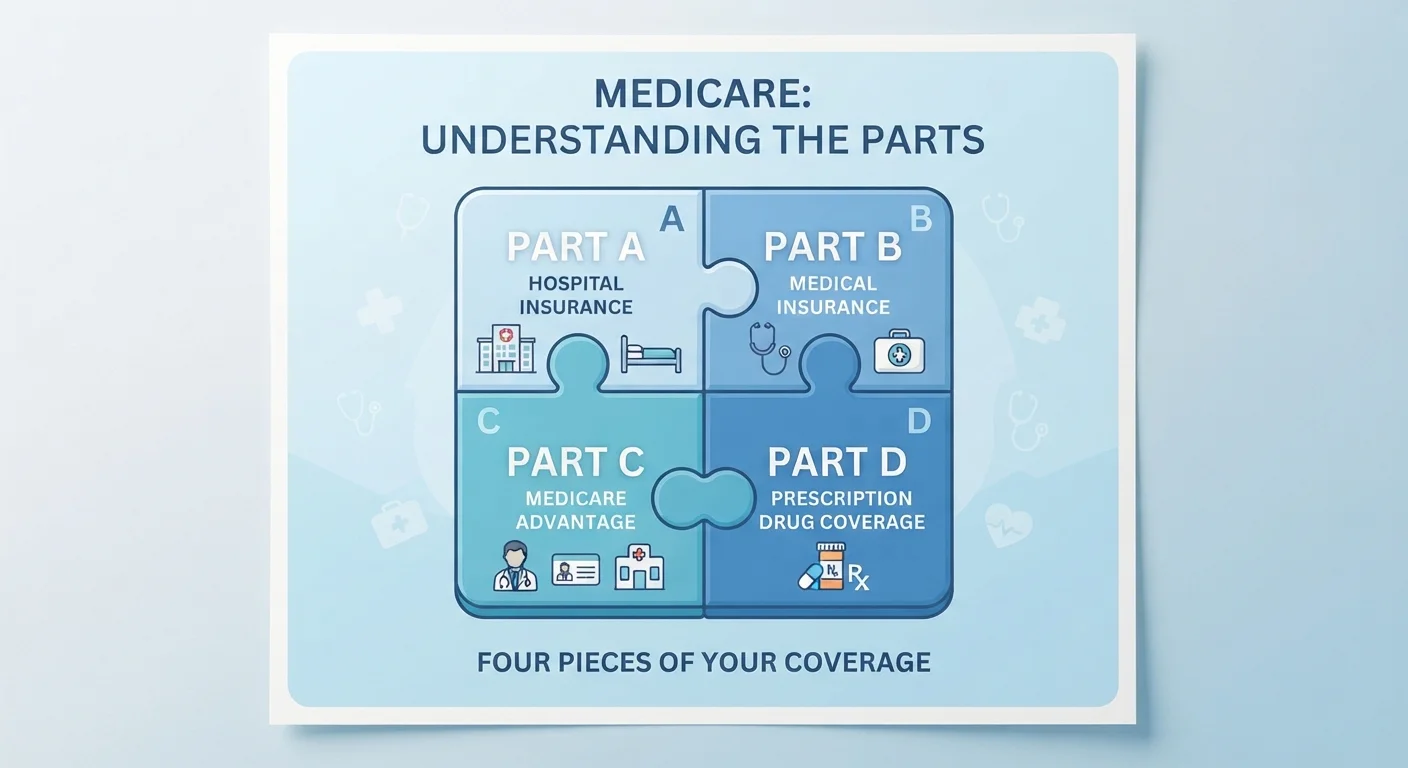
Part A covers inpatient hospital stays, skilled nursing facility care following a qualifying hospital stay, hospice care, and some home health services. Most people pay no monthly premium for Part A if they or their spouse worked and paid Medicare taxes for at least 10 years.
Part B covers outpatient medical services: doctor visits, preventive screenings, lab tests, durable medical equipment, and some home health care. Part B charges a monthly premium, and the amount is based on income reported to the IRS two years prior.
Together, Parts A and B form what is called Original Medicare. This coverage does not cap your annual out-of-pocket costs, which is one reason many people add supplemental coverage. For a detailed breakdown of what each part includes, see Medicare Parts A, B, C, and D explained.
Medicare Advantage (Part C)
Medicare Advantage is an alternative way to receive your Medicare benefits. Private insurers approved by Medicare offer these plans, which must cover everything Original Medicare covers. Many plans also include benefits that Original Medicare does not, such as routine dental, vision, hearing, and fitness programs.
Most Medicare Advantage plans organize care through a network of providers, similar to an HMO (Health Maintenance Organization) or PPO (Preferred Provider Organization). Your costs and flexibility to see out-of-network providers depend on the plan type. Unlike Original Medicare, Medicare Advantage plans have an annual out-of-pocket maximum, which limits how much you can owe in a given year.
Choosing Medicare Advantage means your care is coordinated through the private insurer rather than Medicare directly. This can simplify billing, but it also means the insurer's network and rules apply. Availability and plan details vary by ZIP code.
Free help is available during enrollment
Every state has a State Health Insurance Assistance Program (SHIP) that offers free, unbiased counseling to Medicare-eligible adults. SHIP counselors can walk you through plan comparisons, enrollment steps, and cost-saving programs at no charge.
Prescription drug coverage (Part D)
Original Medicare does not include routine prescription drug coverage. Part D fills that gap. These plans are offered by private insurers approved by Medicare and can be added to Original Medicare or are sometimes bundled into Medicare Advantage plans.
Each Part D plan has a formulary, the list of covered drugs. Drugs are grouped into tiers, and your cost varies by tier. Before enrolling, checking whether your current medications appear on a plan's formulary can help you estimate your annual drug costs.
If you do not enroll in Part D when first eligible and go without creditable drug coverage, you may face a late-enrollment penalty that adds to your premium permanently. People with limited income may qualify for the Extra Help program, which reduces Part D costs significantly.
Medigap: covering what Medicare leaves out
Original Medicare covers many costs but leaves beneficiaries responsible for deductibles, copayments, and coinsurance. Medigap, also called Medicare Supplement Insurance, is private coverage designed to pay some or all of those remaining costs.
Medigap policies are standardized by federal and state law. Plans sold with the same letter designation (such as Plan G or Plan N) must offer the same core benefits regardless of which insurer sells them, which makes comparing policies more straightforward. Premiums vary between insurers for the same plan letter, so reviewing multiple options is worthwhile.
The best time to buy Medigap is during your Medigap Open Enrollment Period, which begins the month you are both 65 and enrolled in Part B. During this window, insurers generally cannot use medical underwriting to deny coverage or charge more based on health conditions. Outside this window, your ability to enroll without medical review may be limited depending on your state. For more on how these policies work, see our guide to Medigap coverage gaps.
Other coverage paths worth knowing
Not every senior follows the same path. Some may have access to retiree health benefits through a former employer, which can work alongside Medicare. Veterans may qualify for health care through the Department of Veterans Affairs; veteran health and benefit programs are worth reviewing if you served.
People with limited income and resources may qualify for both Medicare and Medicaid simultaneously. This is called dual eligibility, and it can reduce or eliminate many out-of-pocket costs. Your state Medicaid office can confirm eligibility criteria.
If you are approaching 65 and still weighing how employer coverage fits in, the open enrollment walkthrough covers the comparison process in detail. Federal and state assistance programs for everyday costs, including prescription help, are outlined in this overview of senior financial assistance programs.
Medicare
A federal health insurance program primarily for people 65 and older, as well as some younger people with qualifying disabilities.
Premium
The fixed monthly amount you pay for health coverage, separate from any costs you pay when you actually use care.
Deductible
The amount you pay out of pocket for covered services before your insurance begins to share the cost.
Medigap
A type of private supplemental insurance that helps pay costs Original Medicare does not fully cover, such as copayments and coinsurance.
Medicare Advantage
An alternative to Original Medicare offered by private insurers that bundles hospital and medical coverage, often with additional benefits.
Formulary
The list of prescription drugs a particular Part D or Medicare Advantage plan covers, organized into tiers that affect your cost.
This article is for general informational purposes only and is not personalized insurance, financial, or medical advice. Coverage options, costs, and eligibility rules vary by individual situation, provider, and state. Consult a licensed insurance agent, a SHIP counselor, or visit Medicare.gov for guidance specific to your circumstances.