


Why your first bill surprises you
A first utility bill often lands higher than expected, and the gap between expectation and reality usually comes down to three things: unfamiliarity with local rates, no prior usage baseline for the home, and the compounding effect of many small loads across a full month.
Utility bills are not one-size-fits-all. Your rate depends on your provider, your state, and sometimes the specific rate plan you were assigned or chose. If your plan uses a tiered or time-of-use structure, your cost per unit of electricity can change based on how much you use or when you use it. See our guide to electricity rate structures for a plain comparison of how these plans work.
Before you can change anything, it helps to know which parts of your home are doing the most work.
Billing cycles vary by provider
Most utilities bill monthly, but the exact cycle length can be 28 to 35 days depending on your provider and meter-reading schedule. Your first bill may cover a partial cycle, making direct month-to-month comparisons tricky until you have two or three full cycles on record.
Heating and cooling: the biggest line on your bill
Your HVAC system is almost certainly your largest single energy expense. In most American households, heating and cooling account for roughly 40 to 50 percent of total energy use, according to the U.S. Energy Information Administration.
Several factors drive that number up or down: the age and efficiency rating of your system, how well the home is insulated, and how wide a gap there is between your indoor thermostat setting and the outdoor temperature. A drafty apartment in a cold climate will push that share higher. A well-sealed newer home in a mild climate will push it lower.
Practical things that affect HVAC costs include how often you change the air filter (a clogged filter makes the system work harder), whether windows and doors seal properly, and whether you use a programmable or smart thermostat to reduce heating and cooling when the space is empty.
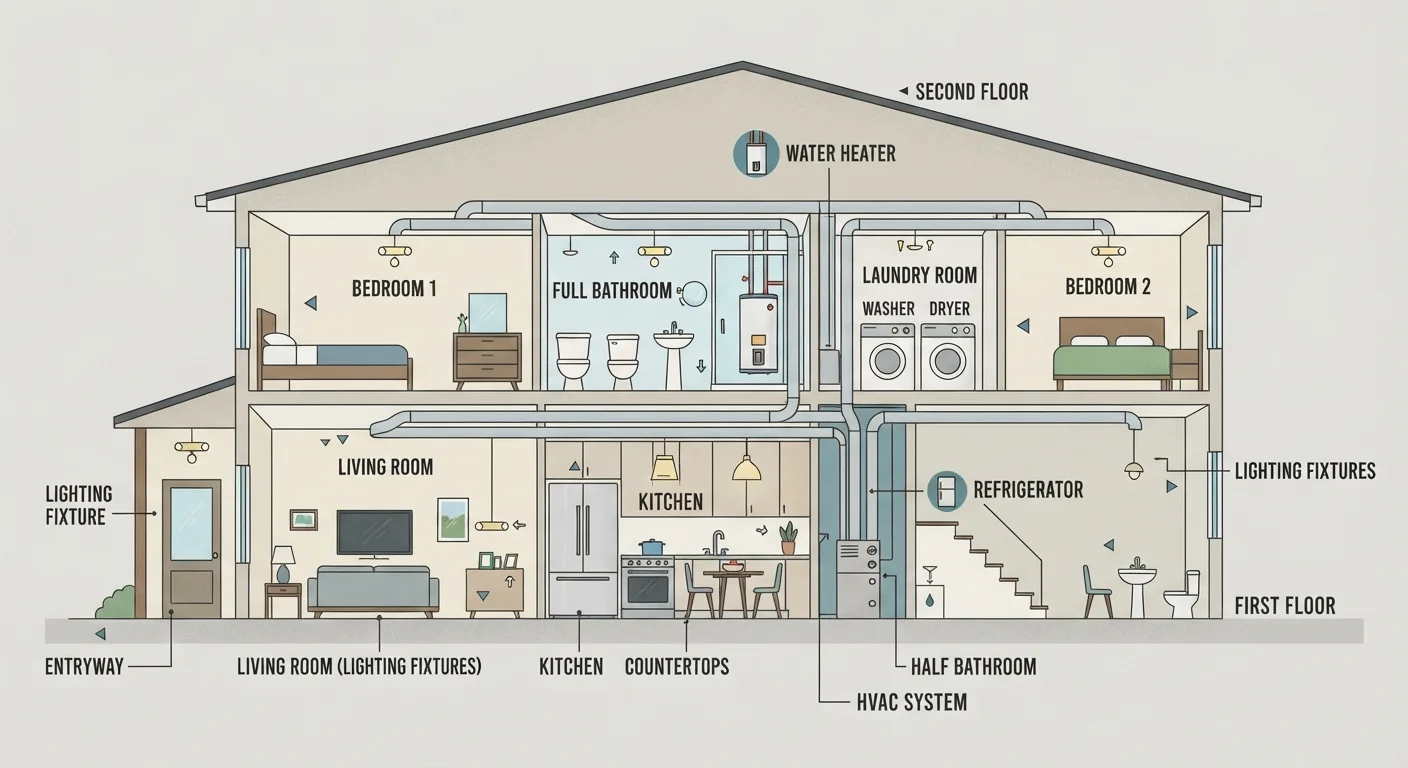
Kitchen: appliances and habits that add up
The refrigerator runs continuously, which makes it one of the more consistent electricity draws in any home, even though it uses less power per hour than the HVAC system. Older refrigerators use significantly more energy than newer models, so the age of the unit matters.
The oven and range are used less often but draw a lot of power when they run. Dishwashers use both electricity and heated water, and their heated-dry cycle alone can account for a meaningful share of each wash. Running full loads and using air-dry settings (if available) reduces both.
Small countertop appliances, things like microwaves, coffee makers, and toasters, add minor amounts individually but can add up across a month if they stay plugged in when not in use, since many draw standby power continuously.
Request a usage history before you move in
Many utilities will share the previous 12 months of energy usage for an address before you sign a lease or close on a home. This gives you a reasonable baseline for budgeting, especially across different seasons.
Bathroom and laundry: water heating costs
Water heating is typically the second-largest energy expense in a home. Every time you run a hot shower, fill a sink, or run a load of warm laundry, your water heater uses energy to maintain or restore its stored temperature.
The length of showers and the temperature setting on your water heater both affect this cost directly. A tank water heater also loses some heat through the tank walls even when no hot water is being used, a process called standby heat loss. Tankless (on-demand) water heaters avoid this, though they have higher upfront costs.
In the laundry room, the clothes dryer is one of the highest-draw appliances in a home. It uses heat to evaporate moisture, which takes significant energy. Washing clothes in cold water reduces the water heating portion of laundry costs without affecting cleaning for most loads.
Do not adjust your water heater without checking safety specs
Lowering a water heater's temperature can reduce energy costs, but setting it too low (below 120 degrees Fahrenheit) may allow harmful bacteria to grow in the tank. Check the manufacturer's guidance and, for gas water heaters, consult a licensed plumber before making changes.
Living room and bedrooms: standby power and lighting
Lighting and electronics together make up a smaller but still meaningful share of home energy use. Switching from incandescent bulbs to LED bulbs is one of the most straightforward ways to reduce this share. LED bulbs use roughly 75 percent less energy than incandescent equivalents for the same light output.
Televisions, gaming consoles, cable boxes, and audio equipment draw standby power even when you consider them to be off. Plugging these into a power strip you actually switch off is an easy way to eliminate that draw without unplugging each device individually.
Laptop and phone chargers left plugged in without a device attached also draw a small continuous current. The individual amounts are small, but across a full household over a full month, the total is measurable.
Reading your bill and taking next steps
Most utility bills show your total kilowatt-hours used, the rate applied, and any fixed charges like service or delivery fees that appear regardless of how much electricity you use. Knowing this breakdown helps you tell whether a high bill came from heavy usage or from a rate increase.
If your bill includes a usage history chart (many do), look for months where consumption spiked. That often corresponds to extreme weather, a new appliance, or a change in occupancy. Contacting your utility to request an account review or a free energy audit is a reasonable step if you cannot explain a sudden jump.
For budgeting purposes, treat your utility bill as a variable expense and plan for seasonal swings. Tying it into a broader monthly spending plan helps. Our guide to building your first budget covers how to categorize variable costs like utilities alongside fixed expenses. If your bill has already strained your finances, signs your budget needs a tune-up covers signals worth watching. When you move, use our new home service setup checklist to make sure utility accounts are in place before move-in day.
Kilowatt-hour (kWh)
The unit utilities use to measure electricity consumption. One kilowatt-hour equals using 1,000 watts of power for one hour, such as running a hair dryer for about an hour.
Standby power
The small amount of electricity a device draws while plugged in but not actively in use. It is sometimes called phantom load or vampire power.
Tiered rate
A billing structure where the price per kilowatt-hour increases once your usage passes a set threshold in a billing period.
Water heater thermostat
A temperature control on your water heater that sets how hot the stored water gets. Higher settings increase energy use and the risk of scalding.
HVAC
Stands for heating, ventilation, and air conditioning. It refers to the system that controls the temperature and air quality inside your home.