


What each coverage actually does
Medical Payments Coverage, usually called MedPay, pays for medical and funeral expenses for you, your passengers, and any household members injured in a crash. It applies whether you were driving your car, riding in someone else's vehicle, or struck as a pedestrian. The coverage pays up to a set dollar limit, and it does so regardless of who caused the accident.
Personal Injury Protection, or PIP, does the same for medical expenses but adds a wider set of benefits. Depending on the state and policy, PIP can cover a portion of lost wages if you cannot work, costs for household services you can no longer perform while recovering, and in some states, survivor benefits. PIP is the coverage type tied to no-fault auto insurance systems, where each driver's own insurer covers their injuries up to policy limits before any liability claim is filed.
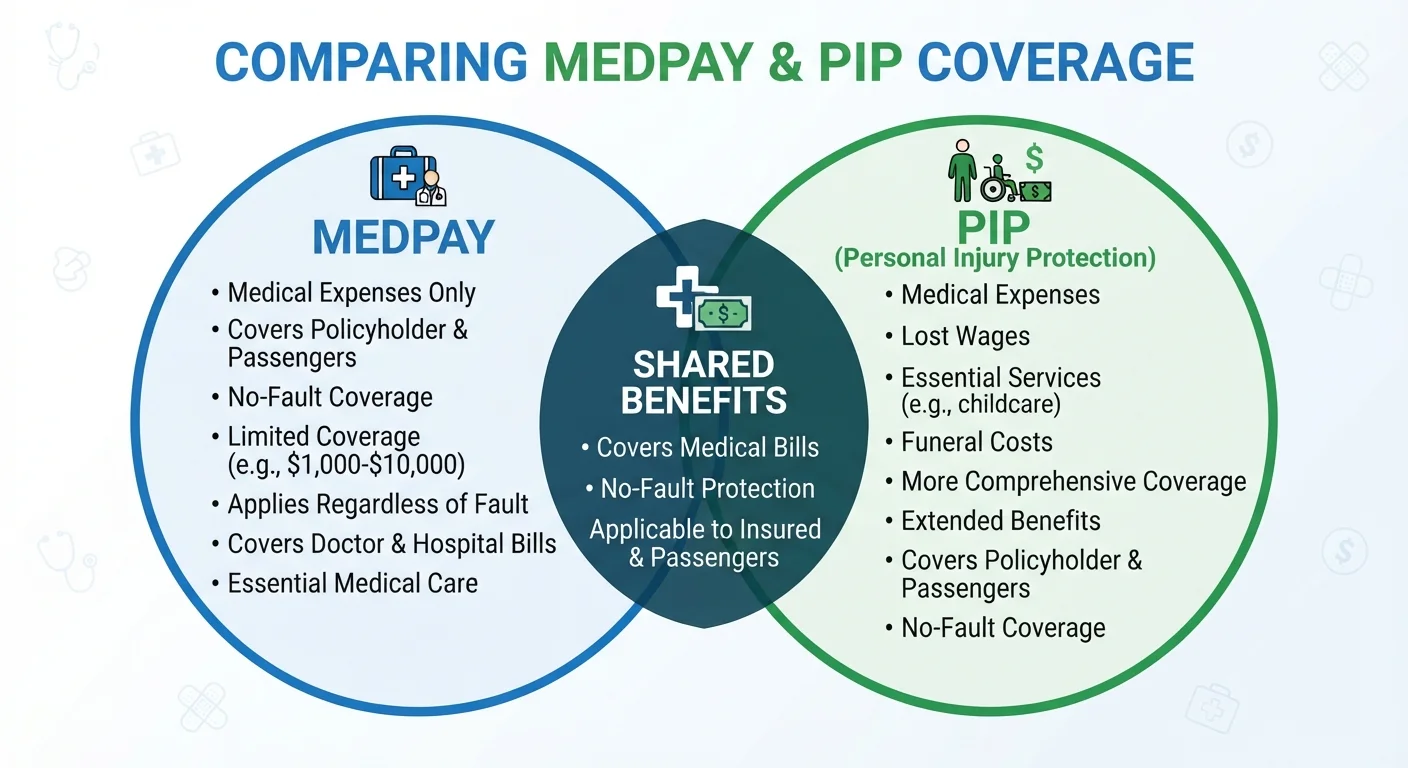
The core distinction: MedPay is narrow and portable; PIP is broader but more complex. Understanding which one applies to you starts with knowing your state's rules.
State rules shape what you can buy
About a dozen states operate under a no-fault system and require drivers to carry PIP. In those states, PIP is not optional; it is the baseline injury coverage the law sets. MedPay may still be available as an add-on in some no-fault states, but PIP comes first.
In the remaining states, which use an at-fault system, PIP may be offered as an optional product or may not be available at all. MedPay is more widely available across at-fault states and is typically offered as an optional endorsement.
State rules change; verify yours directly
No-fault and at-fault designations, PIP minimums, and MedPay availability can change when state legislatures update insurance laws. The information here reflects general patterns across U.S. states. Confirm current requirements with your state's department of insurance or a licensed agent before making coverage decisions.
A few states offer a choice between no-fault and at-fault coverage, which affects whether PIP or MedPay is the more relevant option. Because rules differ by state, the only reliable way to confirm what is available to you is to check with a licensed insurance agent in your state or review your insurer's policy terms directly.
How the two coverages compare directly
| Criterion | MedPay | PIP |
|---|---|---|
| Medical expense coverage | Yes | Yes |
| Lost wage replacement | No | Yes, in most states |
| Household services benefit | No | Yes, varies by state |
| Fault requirement | None | None |
| Availability | Most at-fault states (optional) | Required in no-fault states |
| Typical coverage limits | $1,000 to $25,000 | Varies; set by state minimums |
| Coordinates with health insurance | Varies by policy | Varies by state law |
One practical difference is coordination with health insurance. MedPay typically pays regardless of other coverage, which can help cover out-of-pocket costs your health plan does not absorb. PIP often coordinates with health insurance in ways that vary by state law and insurer. Some states require PIP to pay first; others allow it to pay secondary to health coverage.
Limits for both coverages tend to be lower than major medical insurance. MedPay limits commonly run from $1,000 to $25,000 per person. PIP limits vary more widely by state, since some no-fault states set minimum thresholds by law. Neither coverage is a substitute for adequate health insurance or long-term disability coverage.
If you are comparing overall coverage structures, the differences between HMO and PPO plans can affect how well your health insurance fills in around MedPay or PIP.
When carrying both makes sense
Some drivers in no-fault states carry both PIP (as required) and MedPay to cover costs that exceed PIP limits or fall into gaps not covered by PIP. In at-fault states, a driver with a high-deductible health plan might add MedPay to reduce immediate out-of-pocket costs after an accident without needing to meet a large deductible first.
Seniors enrolled in Medicare should note that Medicare Parts A and B cover some accident-related treatment, but coordination rules between Medicare and auto insurance coverage are specific and worth confirming with both your auto insurer and Medicare directly. Supplemental coverage options, such as those described in Medigap policies, may also interact with auto medical coverage in ways that vary by circumstance.
Drivers who have switched to usage-based programs should also confirm their injury coverage levels, since pay-per-mile and telematics policies adjust premiums based on driving behavior but do not change the underlying coverage types available to you.
This article is for general informational purposes only and is not personalized insurance, legal, or financial advice. Coverage availability, terms, and requirements vary by state and insurer. Read your policy documents carefully and consult a licensed insurance agent for guidance specific to your situation.