


How the compounding mechanic works
At its most basic, compound interest means you earn (or owe) interest on interest. Suppose you deposit $1,000 in a savings account at a 5% annual rate, compounded annually. After year one, you earn $50, giving you $1,050. In year two, the 5% rate applies to $1,050, not the original $1,000, so you earn $52.50. The balance grows faster each year without any additional deposits.
The two variables that most affect the final amount are the interest rate and time. A higher rate accelerates growth, but a longer period produces a larger total because each compounding cycle builds on a bigger base. A third variable, compounding frequency, also matters: daily compounding produces a slightly higher balance than annual compounding at the same stated rate, because interest joins the principal more often.
Financial institutions typically express savings account returns as an annual percentage yield (APY), which already accounts for compounding frequency. Loan costs are expressed as an annual percentage rate (APR), which may or may not reflect compounding depending on the loan type. Reading these figures carefully lets you compare accounts and loans on equal terms.
Compound interest working in your favor: savings
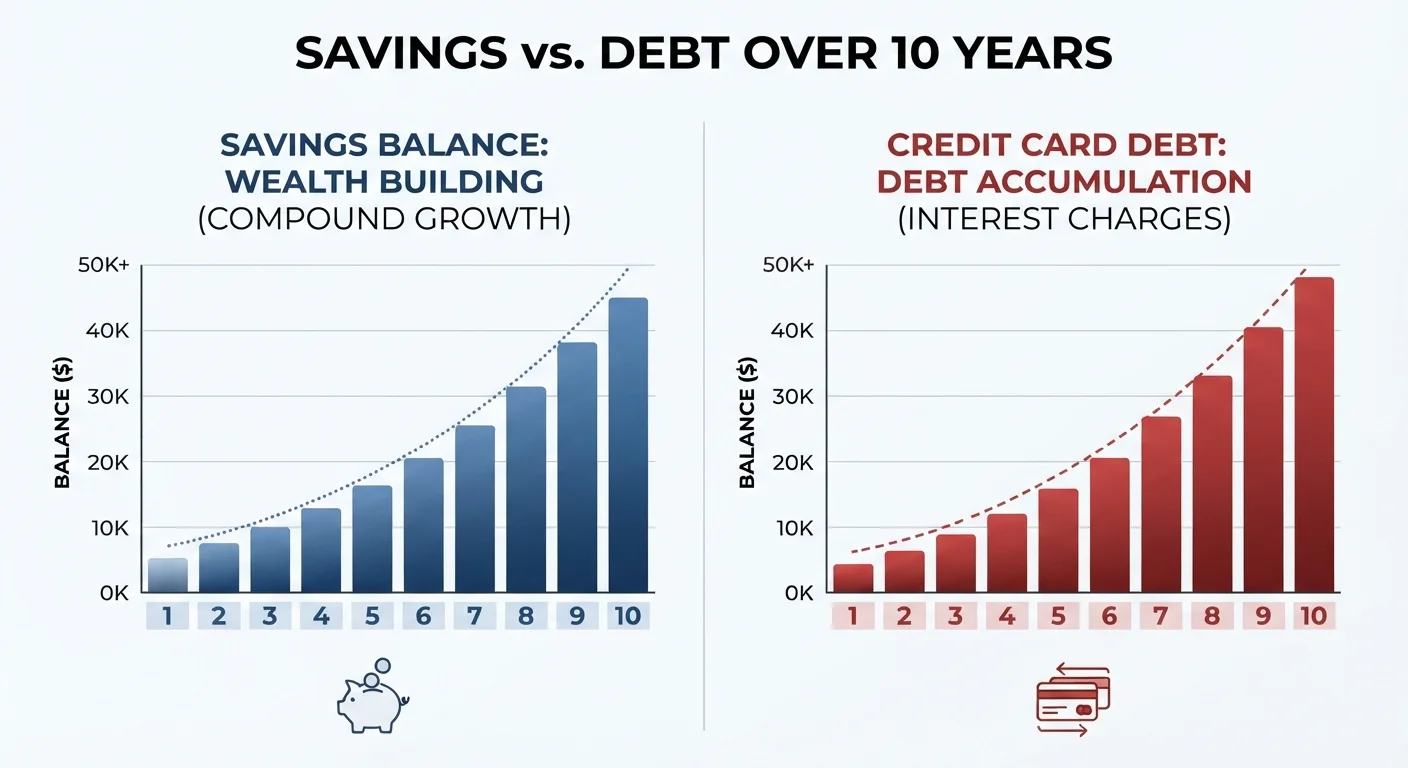
For a savings account or similar deposit product, compound interest means the account balance generates returns on its own accumulated earnings. The practical effect is that you do not need to make a large lump-sum deposit to see meaningful growth over a decade or more. Regular, modest contributions that benefit from compounding can produce larger balances than sporadic large deposits, though outcomes depend on the rate, frequency, and time involved.
Because time is the main driver, starting earlier generally matters more than the size of an individual contribution. Someone who saves a modest amount each month for 30 years will typically accumulate more than someone who saves a larger amount for 10 years, assuming the same rate and no withdrawals. This is general illustration, not a projection or guarantee.
When comparing deposit accounts, the APY is the figure that captures the real return including compounding. See how high-yield and traditional savings accounts differ in the rates and requirements they carry, since a higher APY compounds on the same balance to produce a noticeably different outcome over years.
Check the APY, not just the rate
When comparing savings accounts, use the annual percentage yield (APY) rather than the stated interest rate. The APY already incorporates the effect of compounding frequency, so it gives you a direct comparison between accounts that compound at different intervals.
Compound interest working against you: debt
The same mechanic that grows savings also expands debt balances. Credit cards typically calculate interest daily on the outstanding balance. If you carry a $2,000 balance at a 20% APR and make only minimum payments, the daily interest charges are added to the principal, and the next day's interest is calculated on that larger amount. Over months, the balance can grow substantially even without new purchases.
Minimum payments are set low enough that most of the payment covers interest rather than principal. This keeps the base balance high, which keeps interest charges high, which keeps the balance growing. Common credit card myths include the belief that carrying a small balance is neutral or even helpful; in practice, any unpaid balance is subject to compounding charges.
Auto loans and personal loans also use interest, though they are often structured as amortizing loans where a fixed payment schedule gradually reduces the principal. The compounding effect is still present in the early months when most of each payment goes toward interest rather than principal.
This article is for general informational and educational purposes only and does not constitute personalized financial, tax, or legal advice. Consult a licensed financial professional before making decisions based on your individual circumstances.
Putting the concept to practical use
Understanding compound interest lets you ask better questions when opening accounts or taking on debt. For a savings product, ask about the APY and how often interest compounds. For a loan, review the APR and whether interest accrues daily. These figures, found in the account disclosures or loan agreement, show what compounding actually costs or earns over the life of the product.
If your budget has gaps that limit how much you can set aside, reviewing your budget for signals it needs adjustment may free up room for consistent contributions. Small, steady amounts benefit more from compounding over time than the same total saved irregularly. For anyone starting to build a financial history, steps for establishing credit responsibly are worth understanding alongside how interest on new accounts will compound.