


Where a credit score comes from
Three companies collect financial data on American consumers: Equifax, Experian, and TransUnion. Each maintains its own credit report for each consumer, and scoring models read those reports to produce a number. Because the three bureaus do not always hold identical data, your score can differ slightly depending on which bureau's report a lender pulls.
FICO and VantageScore are the two dominant scoring models. FICO Scores are used in the vast majority of lending decisions in the United States. VantageScore was introduced by the three bureaus in 2006 as an alternative, and it uses a similar 300-to-850 range. Both models weigh the same broad categories of credit behavior, though their precise formulas differ.
Lenders submit account data to bureaus on their own schedules, typically monthly. That means your credit report is not a real-time record; there is usually a lag between an event and when it appears in your score.
The five factors in a FICO Score
FICO publishes the five categories it uses and their approximate weights. Understanding each one helps explain why certain financial decisions move a score up or down.
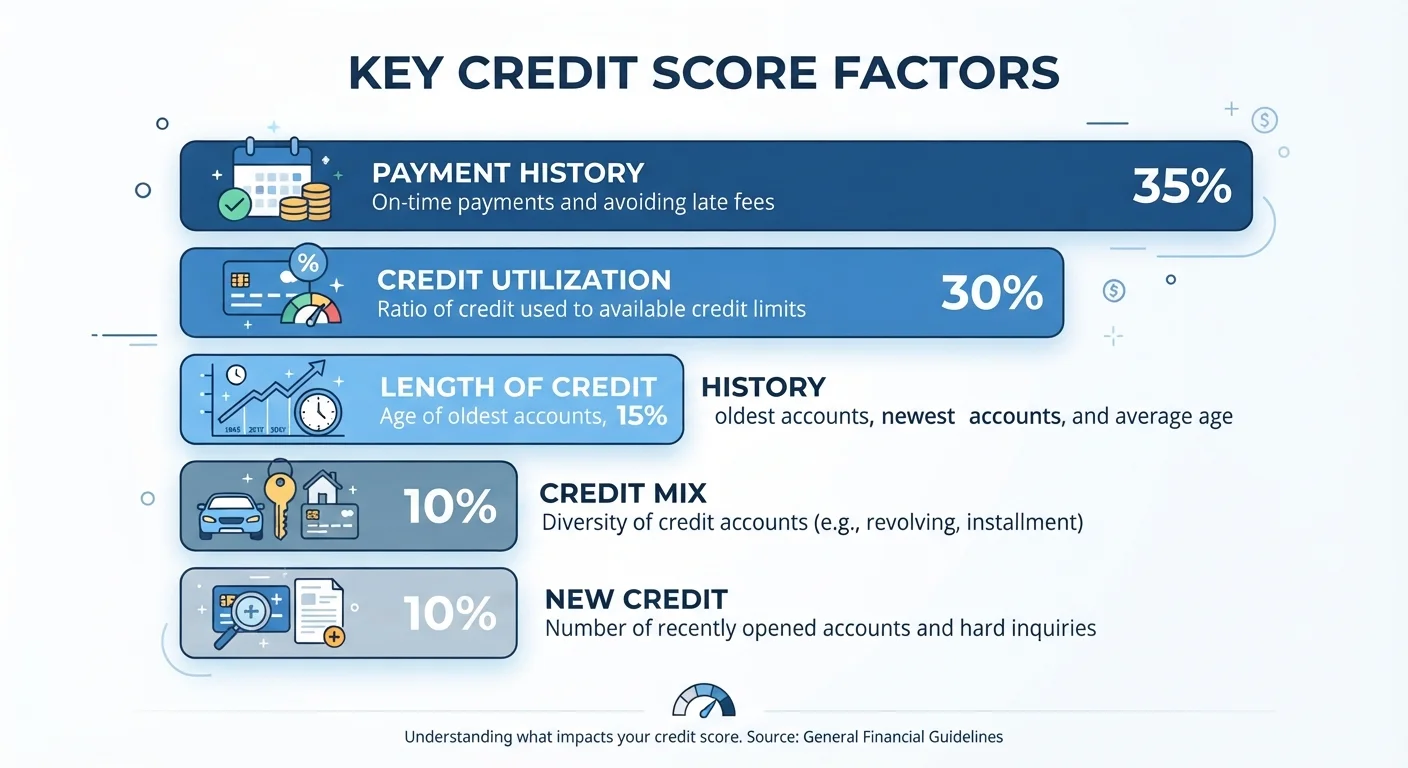
- Payment history (35%). Whether you pay on time is the single largest factor. One payment that is 30 or more days late can lower a score meaningfully, and the effect grows if the payment is later sent to collections.
- Amounts owed (30%). This measures how much of your available revolving credit you are using, a figure called credit utilization. Using a high share of your credit limit signals financial strain to scoring models. Keeping utilization below 30% is a commonly cited guideline, though lower is generally better.
- Length of credit history (15%). Longer histories give models more data to assess patterns. This factor considers the age of your oldest account, your newest account, and the average age across all accounts.
- Credit mix (10%). Having both revolving accounts (such as credit cards) and installment loans (such as a car loan or mortgage) can benefit a score modestly. Opening accounts purely for mix is not necessary and may cause short-term dips.
- New credit (10%). Applying for several new credit lines in a short window results in multiple hard inquiries and can lower a score temporarily. Rate shopping for a single mortgage or auto loan within a short period is typically treated as one inquiry by FICO.
Your free annual credit reports
Federal law gives consumers the right to one free credit report per year from each of the three major bureaus through AnnualCreditReport.com. Reviewing your reports lets you spot errors or signs of fraud before they affect a score. Disputing inaccurate information directly with the bureau is a consumer right under the Fair Credit Reporting Act.
Why lenders and others pay attention
A credit score gives lenders a fast, standardized way to estimate risk. A higher score generally makes it easier to qualify for a loan and may affect the terms a lender offers. A lower score can result in a loan denial or less favorable conditions. This is general information; actual lending decisions depend on many factors beyond the score alone, including income, assets, and the specific lender's criteria.
Credit scores also come up outside traditional lending. Landlords in many states can check credit as part of a rental application. Insurers in most states are permitted to factor credit history into auto insurance premiums through a separate calculation called an insurance-based credit score. That score is not the same number a lender sees. You can learn more about how that works in our article on how insurers use credit scores for auto insurance rates.
Employers in some industries may also review credit reports (though not scores) as part of background checks, where state law permits it.
This article is for general informational purposes only and does not constitute financial or legal advice. Consult a licensed financial professional for guidance specific to your situation.